


Carbon Intelligence Suite
Green concrete reports your team and customers actually understand.
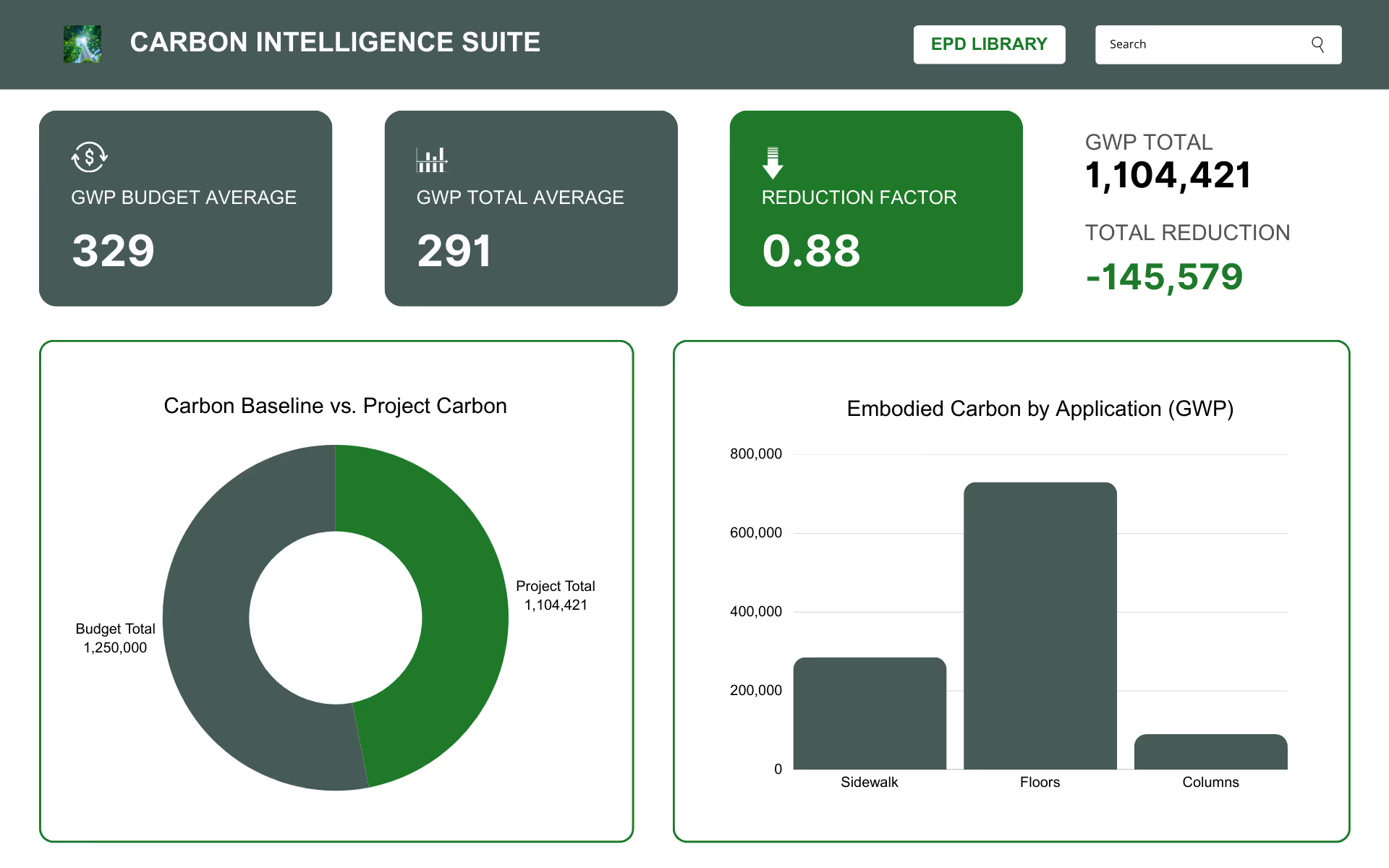

Concrete Carbon Reports That Multiply Results.
Turn mix design data into clear, verified, and actionable low carbon insights.
Automate EPDs at scale.
EPD generation for every plant, mix, and product line all verified to meet global and regional standards.

️Fully Automated Verification
EPD software backed by live plant data and verified automatically through recognized certification bodies.

Expert + System Backed Accuracy
EPD software that finds data errors before they become problems — then our experts confirm every number before it’s finalized.

Experts On-Call
Real support from specialists in both concrete and sustainability compliance.

Save Time, Stay Compliant
Eliminate manual paperwork while meeting every major reporting and verification standard.
Project-Level Carbon Clarity.
Generate carbon reports based on any regulation or requirement you face.

Compare & Benchmark Projects
Measure carbon performance against carbon budgets or regional benchmarks in one dashboard.

Confident Customer Conversations
Show data-backed reasons for choosing certain mixes — making carbon discussions clear, not combative.

Project-Based Carbon Reports
Generate verified EPD and LCA results automatically per project, aligned with ISO 14025, EN 15804, and PCR standards.

Influence Specs with Data
Provide clear evidence to justify mix adjustments, rewrite outdated specs, and win approvals faster.
Green Concrete. Simplified.
Adjust your mix and instantly see what’s driving your carbon numbers up or down — no waiting, no guessing.

Real-Time Carbon Impact:
Concrete mix design editing: instantly view changes in performance, cement content, and embodied carbon.

Root Cause Insights:
Quickly identify which materials or suppliers increase your carbon impact — powered by verified LCA data.

Supply Chain Made Simple:
No more digging for supplier data or haul distances. We automate it all and make sure your numbers are right before reports go out.

Smarter Decisions, Faster:
See cost and carbon trade-offs side-by-side, empowering QC and production teams to improve performance without guesswork.
Frequently Asked Questions
Climate Earth is the leader in carbon reporting for the concrete sector, and we are here to answer your questions.
You don’t have to create EPDs manually anymore — software tools can produce EPDs on-demand for some product categories. This “generation” capability works by inputting plant and production data (verified by a third party) into a software tool that has also been pre-verified by a third party. That means faster EPDs, fewer errors, and full compliance without the paperwork. Automation saves time while keeping you in compliance.
Not everywhere yet — but it’s quickly becoming standard. Europe is moving toward requiring verified carbon data for many construction products as CPR revisions and the planned Digital Product Passport (DPP) drive product-level reporting — timelines are evolving and producers issuing product-specific verified EPDs will be best positioned.
In the U.S., Buy Clean policies at the state and local level already require EPDs for many projects. Private developers, especially large corporations with sustainability targets, are also asking for EPDs more and more. These dynamics are global: different regions and programs are phasing in product-level reporting at different speeds, so producers issuing product-specific verified EPDs are best positioned worldwide.
EPDs and LCAs follow a few main international rules. ISO 14025 sets the basics for Type III EPDs, and ISO 14040/14044 define how LCAs are done. For construction materials, there are two big “core rulebooks”: ISO 21930 (global) and EN 15804 (Europe/CPR). Most industries or countries also add a “Part B” or product-specific rules on top of those core standards.
Different programs or regions will require a certain version of these standards. Climate Earth will always check which core standard and which Part B applies to your product and region before creating your EPDs, so you don’t have to worry about choosing the wrong one.
A Life Cycle Assessment (LCA) measures a product’s environmental impacts across its life stages. An Environmental Product Declaration (EPD) is the third-party verified report that summarizes that LCA — think of it as the product’s carbon “nutrition label.” EPDs give customers, regulators, and owners credible proof of a mix’s environmental performance.
Carbon reporting shows the carbon footprint of your mixes (usually in kg CO₂-e). The simplest, most trusted way to share this is with a verified EPD. More and more regulators and customers now require EPDs to buy concrete — but the rules are different everywhere.
Because of that, having your own verified, product-specific EPDs is the safest option. They work across states, countries, and programs, help you stay compliant, and make it easier to win jobs where low-carbon concrete or carbon transparency is required.
Win in a low-carbon concrete driven market.
Capture sustainable concrete projects with the Climate Earth platform.