


How to Read a Concrete EPD: A Field Guide

Concrete Environmental Product Declarations (EPDs) are packed with technical data, yet they are frequently misinterpreted as a simple "leaderboard" for sustainability. While these documents standardize disclosure, they are not naturally intuitive. Correct interpretation is vital for designers, specifiers, and procurement teams who must rely on this data for compliance and as-built modeling.

The Foundation: Product Scope and Units
Before diving into the numbers, you must verify exactly what material the document represents.
- Product Definition: Check if the EPD represents a specific mix design, a performance group (e.g., all 4,000 psi mixes), or a geographic average.
- Declared Unit: The declared unit defines the exact quantity and performance quality of concrete to which all environmental impacts are normalized—most commonly one cubic meter (1 m³).
- If two EPDs use different units (e.g., metric vs. imperial volumes), they are reporting data for inherently different material realities.
- Because results are scaled to this specific "denominator," treating EPDs with mismatched units as equivalent is a fundamental technical error in data interpretation.
- System Boundaries: These define which life cycle stages are included in the EPD. While many programs focus on "Cradle-to-Gate" (Modules A1–A3), which covers raw material extraction through manufacturing, other regional frameworks increasingly include downstream modules like transportation to job site (A4), construction (A5), use-phase performance (B), and end-of-life (C). Understanding which stages are included—and which are excluded—is critical for ensuring the data is used correctly in broader building-level assessments.

Navigating Environmental Impact Indicators
Concrete EPDs report multiple indicators derived from a Life Cycle Assessment (LCA). While one indicator often dominates the conversation, a truly informed decision requires looking at the full spectrum of reported data.
The Primary Metric: Global Warming Potential (GWP)
GWP is the most widely recognized indicator, reporting a product's "carbon footprint" in kilograms of carbon dioxide equivalents (kg CO₂-eq). In concrete, this value is primarily driven by cement content and sourcing. However, small numerical differences in GWP between two EPDs may simply reflect local energy grid assumptions, background data choices, or transportation distances rather than actual material efficiency.
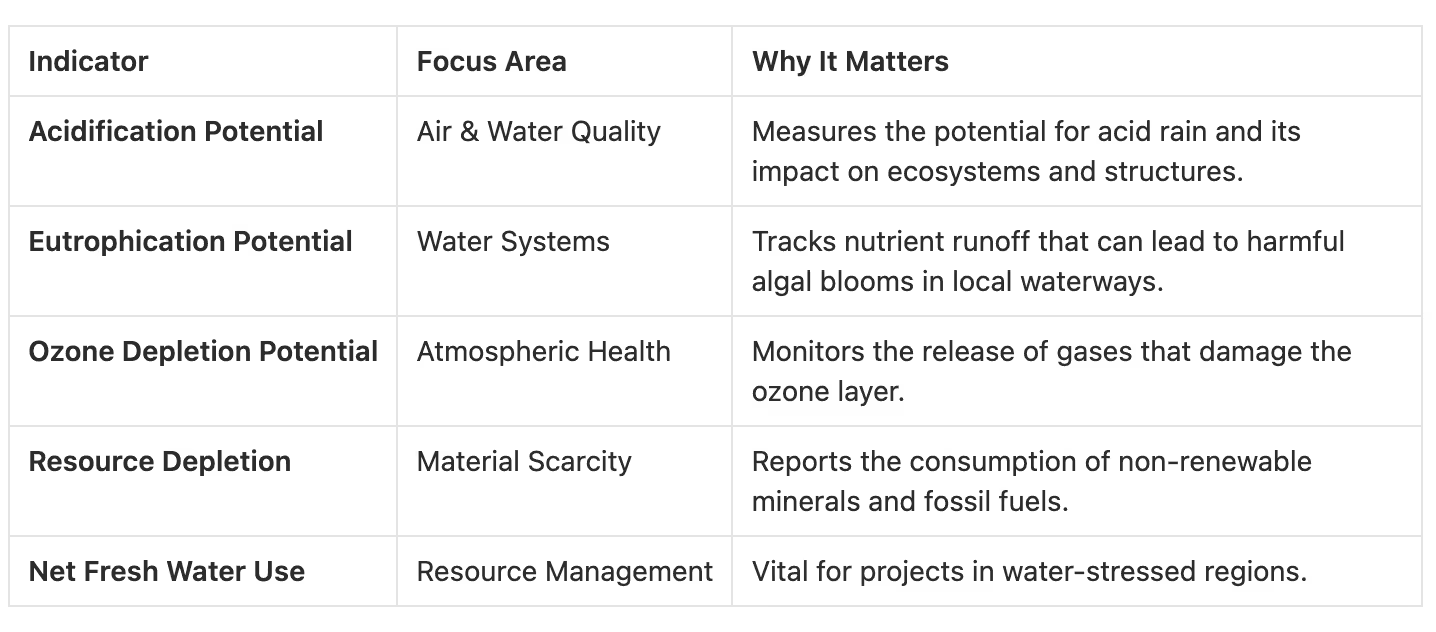
Additional Environmental Indicators
Beyond carbon, EPDs provide data on other environmental pressures that can be critical depending on the project’s specific sustainability goals. A few examples are listed below:
The Fine Print: Data Sources and Verification
Transparency is the core of an EPD. When reviewing the document, look for these markers of reliability:
- Primary vs. Secondary Data: Primary data reflects actual measured conditions at the plant, while secondary data relies on generic industry averages. EPDs with higher primary data resolution are generally more representative of real-world production.
- Third-Party Verification: This checkpoint confirms that the EPD complies with international standards—specifically ISO 14025 for Type III environmental declarations—and the applicable Product Category Rules (PCRs). Verification evaluates whether the methodology was applied correctly and that data was handled according to defined rules. It is a confirmation of procedural integrity and transparency, ensuring the document is a credible disclosure rather than a self-declared claim.
- Validity Period: EPDs are typically valid for five years. Expired documents may not reflect current material sourcing or plant investments.
Using EPDs Responsibly
EPDs are best used as disclosure tools to support reporting and high-level benchmarking. They should not replace engineering judgment or project-specific performance evaluations. By acknowledging their value and respecting their limitations, stakeholders can use EPD data to make more informed, disciplined decisions.

Frequently Asked Questions (FAQs)
Does a lower GWP value on an EPD always mean a product is more sustainable?
Not necessarily. GWP only measures carbon emissions. A product could have a very low GWP but a high impact on water use or resource depletion. Sustainability requires looking at all indicators in context.
Can I use an EPD to predict how concrete will perform on my jobsite?
No. EPDs are environmental disclosures, not performance certifications. They do not account for structural durability, workability, or curing times—factors that must be evaluated by your engineering and technical teams.
Why do system boundaries vary across different concrete EPDs?
System boundaries are not discretionary; they are dictated by the regional PCR to ensure consistency within a specific market. Some frameworks prefer "cradle-to-gate" boundaries because those stages are within the manufacturer’s direct control. Other frameworks require broader boundaries to capture the full environmental impact over a product's entire service life, though these often rely on more hypothetical use-phase scenarios.
Have questions? Want to learn more? Check out Climate Earth.

Find out how Climate Earth can help you win more big business.
Browse all blogs

CALGreen: A Guide for Ready-Mix Producers and Construction Leaders

Net Zero Building Examples: Practical Insights for Concrete Producers
